Custom Lanyard Size Guide: Widths, Lengths, Print Options
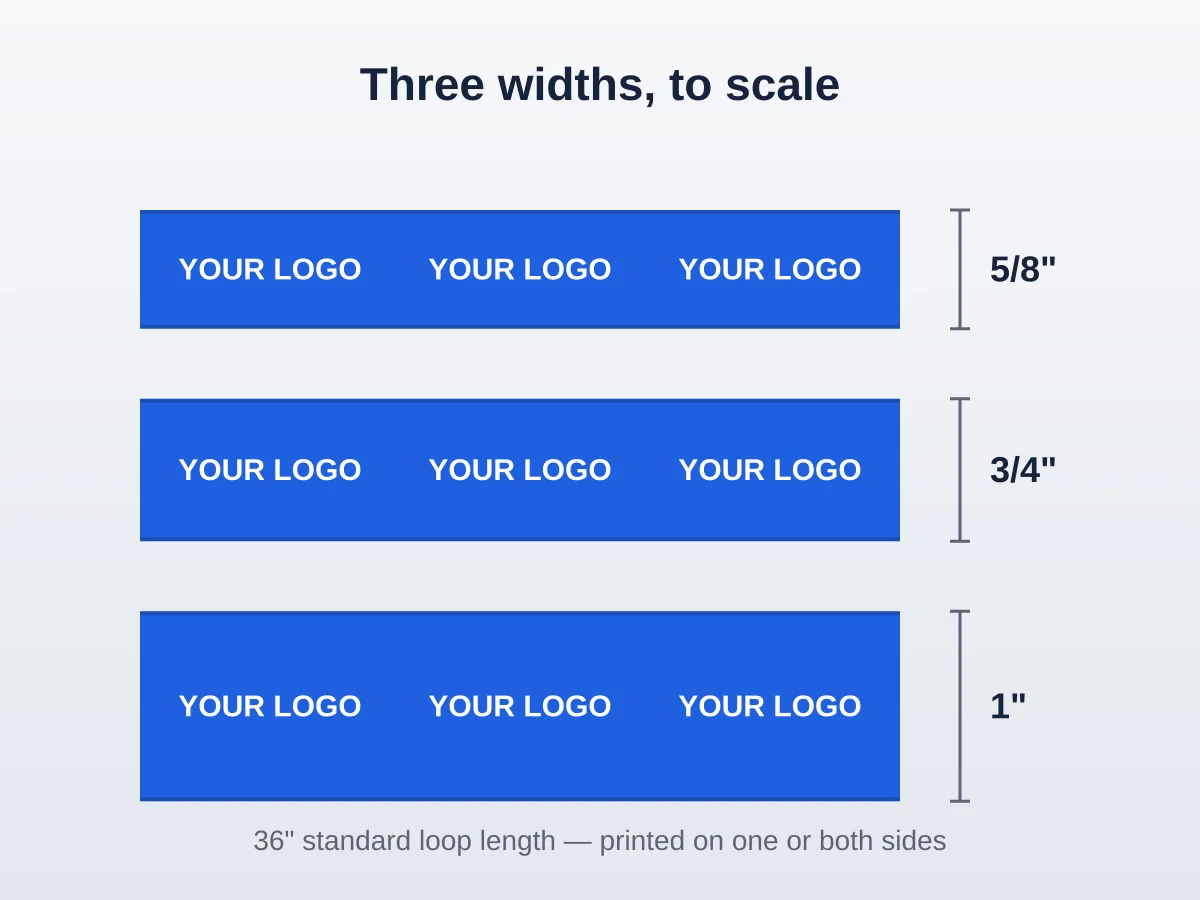
The standard custom lanyard in our range is a 36 inch (91 cm) loop in a 5/8 inch, 3/4 inch or 1 inch (1.6, 1.9 or 2.54 cm) width. Those are the sizes published on our custom lanyards page. If a badge holder needs a longer or shorter drop, that is confirmed on the proof rather than picked from a second published length list.
Custom Lanyard Sizes: A Quick Size Guide
A lanyard is the strap a badge, ID card or exhibitor pass hangs from. The two measurements that matter on our product page are width (how wide the strap is) and loop length (published as a 36 inch standard loop). We do not publish a separate neck-drop figure, a thickness, or a weight for the finished lanyard, so order by the width and the 36 inch loop, and tell us if the drop needs to change.
| What is published | Inches | Centimetres |
|---|---|---|
| Narrower width | 5/8" | 1.6 cm |
| Mid width | 3/4" | 1.9 cm |
| Wider width | 1" | 2.54 cm |
| Standard loop length | 36" | 91 cm |
The inch-to-centimetre factor for this table is 2.54. The centimetre figures above are rounded to the nearest 0.1 cm except for the 1 inch width, which is exact (5/8 × 2.54 = 1.5875 cm, shown as 1.6; 3/4 × 2.54 = 1.905 cm, shown as 1.9; 36 × 2.54 = 91.44 cm, shown as 91). Name the unit in the same instruction so the proof is drawn to the size you meant.
Quantities run from 100 to 10,000. The lanyards ship printed and finished with the attachment you choose. A badge holder or ID card is not included.
Standard Lanyard Width and Length
Width is the choice most people make first, because it changes how much room the imprint has and how the strap feels against the neck.
- 5/8 inch is the narrower published width. It leaves a slimmer strap and a smaller area for the imprint.
- 3/4 inch sits in the middle of the three published widths.
- 1 inch is the wider published width, with the most room for a logo or a line of text.
Length is published as a 36 inch standard loop. That is the default on the product page. We do not publish a chart that converts the loop length into a drop measurement, and we do not publish separate adult, child or "badge-only" lengths. If the badge holder needs a longer or shorter drop, say so on the quote and it is confirmed on the proof.
Lanyard Dimensions in Inches and Centimetres
Trade show and event work in the United States usually specifies lanyards in inches, which is why the product page lists 5/8", 3/4", 1" and 36". The same sizes can be written in centimetres, as in the table above, if a Canadian or metric artwork file needs them. Do not mix units in the same instruction (for example, a 1 inch width with a 91 cm loop) without saying that both refer to the published standard size.
We do not publish a tolerance, a stretch figure, or a finished circumference for the worn loop, so treat the numbers above as the sizes you order, not as a worn-fit chart.
How to Choose a Lanyard Size for Your Event
- Pick a width from the three published options. Use 1 inch when the logo or wordmark needs more horizontal room; use 5/8 inch when you want a slimmer strap.
- Start from the 36 inch standard loop. Only ask for a different drop if the badge holder or the way the pass is worn needs it.
- Choose an attachment: swivel hook, bulldog clip, split ring or cell phone loop. A breakaway safety clasp can be added to any of them, which is worth considering at a staffed booth where a lanyard might catch on equipment.
- Decide whether the imprint is on one side or both. A double-sided imprint repeats the design, or a second message, along the length so it still reads when the lanyard twists.
If you are also planning the rest of the booth kit, the trade show booth checklist covers the other pieces that usually sit alongside badges and passes. The product page says ordering lanyards with a canopy or a backdrop is how booth staff match the branding behind them. That backdrop can be a step and repeat backdrop.
Wide vs Narrow Lanyards: Which Width Should You Choose?
"Narrow" and "wide" in this range simply mean the ends of the published width list: 5/8 inch versus 1 inch, with 3/4 inch in between. We do not publish a rule that one width is required for a given event type, logo size or badge style. The practical difference is imprint area and how bulky the strap feels. If the artwork has a short wordmark or a simple icon, any of the three widths can carry it. If the artwork is a longer line of text, the 1 inch width gives it more room.
There is no published minimum logo size for each width. The free proof is where you see whether the imprint reads clearly at the width you chose.
Lanyard Materials: What Are the Options?
The product page lists polyester, nylon, woven and tubular, and the same material menu includes full-colour dye sublimation. Polyester or nylon is the option for a clean one- or two-colour imprint, and woven or tubular is the heavier feel. Dye sublimation is the printing method for artwork with gradients or photography, not a fifth fabric. We do not publish a fabric weight, a thread count, a water rating or a softness grade for any of them, so do not treat one material as "indoor only" or "outdoor only" unless that is confirmed on the quote.
Choose the material for feel and for the kind of imprint the artwork needs, then confirm both on the proof.
Lanyard Printing Options and Design Considerations
- One- or two-colour imprint on polyester or nylon, when the logo is a simple colour set.
- Full-colour dye sublimation when the artwork has gradients or photography, or more than a couple of colours.
- One side or both sides. A single-side imprint is standard. A double-sided imprint is the option when the lanyard should still read after it twists.
Artwork for a one- or two-colour imprint is a print-ready vector file (AI, EPS or PDF) with fonts outlined. Dye-sublimated full-colour artwork can be supplied as high-resolution CMYK art instead. Every file is checked at no charge and a free proof is sent before printing. Related handouts, such as 16pt matte business cards, have their own size rules — see the business card size guide if you are ordering cards at the same time. Other marketing print lives on the marketing essentials category page.
We do not publish a maximum imprint length, a pantone-matching guarantee, or a wash or fade rating, so those details stay on the quote and the proof.
What Lanyard Length Works Best for Adults and ID Badges?
The length we publish for this product is the 36 inch standard loop, and it is the length to start from for adult staff and attendee badges. We do not publish a separate adult length, a child length, or a recommended drop for a given badge-holder size. If the holder, the pass, or the way people wear the lanyard needs a longer or shorter drop, put that on the quote and confirm it on the proof before the run is printed.
The attachment does not change the published loop length. It only changes how the badge or pass connects: swivel hook, bulldog clip, split ring or cell phone loop. Add the breakaway clasp when there is a chance the lanyard could catch.
Frequently asked questions
What is the standard size of a lanyard? In our range the published standard is a 36 inch (91 cm) loop. Widths are 5/8 inch, 3/4 inch or 1 inch (1.6, 1.9 or 2.54 cm). A longer or shorter drop is confirmed on the proof if the badge holder needs it.
What width should I choose for a custom lanyard? Choose from the three published widths: 5/8 inch, 3/4 inch or 1 inch. The 1 inch width gives the imprint the most room; 5/8 inch is the slimmer strap. There is no published rule that ties one width to a specific event type.
How long should a lanyard be to hold an ID badge? Start with the 36 inch standard loop. We do not publish a separate badge-holder drop chart. If the holder needs a longer or shorter drop, tell us on the quote and we confirm it on the proof.
What materials are commonly used for custom lanyards? Polyester, nylon, woven and tubular, plus full-colour dye sublimation, as listed on the product page. Polyester or nylon is the usual choice for a one- or two-colour imprint; woven or tubular is described as the heavier feel. Dye sublimation is the print method for gradients or photography, not a separate fabric.
Which printing method is best for a lanyard design? Use a one- or two-colour imprint on polyester or nylon when the logo is a simple colour set. Use full-colour dye sublimation when the artwork has gradients, photography, or more than a couple of colours. Print one side, or both sides if the design should still read when the lanyard twists.
Frequently asked questions
What is the standard size of a lanyard?
In our range the published standard is a 36 inch (91 cm) loop. Widths are 5/8 inch, 3/4 inch or 1 inch (1.6, 1.9 or 2.54 cm). A longer or shorter drop is confirmed on the proof if the badge holder needs it.
What width should I choose for a custom lanyard?
Choose from the three published widths: 5/8 inch, 3/4 inch or 1 inch. The 1 inch width gives the imprint the most room; 5/8 inch is the slimmer strap. There is no published rule that ties one width to a specific event type.
How long should a lanyard be to hold an ID badge?
Start with the 36 inch standard loop. We do not publish a separate badge-holder drop chart. If the holder needs a longer or shorter drop, tell us on the quote and we confirm it on the proof.
What materials are commonly used for custom lanyards?
Polyester, nylon, woven and tubular, plus full-colour dye sublimation, as listed on the product page. Polyester or nylon is the usual choice for a one- or two-colour imprint; woven or tubular is described as the heavier feel. Dye sublimation is the print method for gradients or photography, not a separate fabric.
Which printing method is best for a lanyard design?
Use a one- or two-colour imprint on polyester or nylon when the logo is a simple colour set. Use full-colour dye sublimation when the artwork has gradients, photography, or more than a couple of colours. Print one side, or both sides if the design should still read when the lanyard twists.