Business Card Size Guide: Standard Dimensions, Bleed and Paper Options
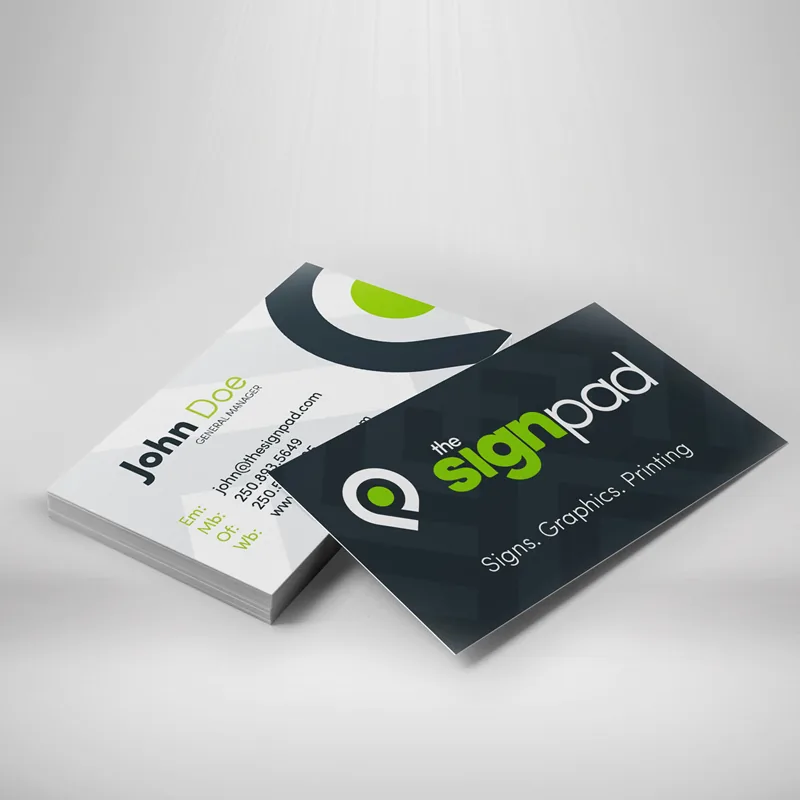
The standard business card in the US and Canada is 3.5 x 2 inches (88.9 x 50.8 mm). Build your file a little larger than that, with bleed, keep text inside a safe margin, and choose a stock thick enough to survive a pocket. This guide covers each of those numbers.
What Is the Standard Business Card Size?
3.5 inches wide by 2 inches tall, landscape. A vertical card uses the same size turned on its side: 2 inches wide by 3.5 inches tall. Our 16pt matte business cards are cut to this standard 3.5" x 2" size.
Business Card Dimensions in Inches, cm and Pixels
| Measurement | Trim size (finished card) | With 1/16" bleed on all sides |
|---|---|---|
| Inches | 3.5 x 2 in | 3.625 x 2.125 in |
| Millimetres | 88.9 x 50.8 mm | 92.1 x 54.0 mm |
| Centimetres | 8.89 x 5.08 cm | 9.21 x 5.40 cm |
| Pixels at 300 dpi | 1050 x 600 px | about 1088 x 638 px |
The pixel figures are the inch figures multiplied by 300, because print files for cards are set up at 300 dpi. A design built at screen resolution (72 or 96 dpi) at these pixel sizes will print soft.
Business Card Bleed Size and Safe Margins
Bleed is extra artwork that runs past the edge of the card. The cutter works to a small tolerance, so a background built exactly to 3.5" x 2" can leave a thin white edge on one side. For our cards, add a 1/16" (about 1.6 mm) bleed on all four sides, which makes the file 3.625" x 2.125".
Safe margin is the opposite: keep text and logos clear of the trim, inside the card, so nothing important is cut close. Anything that touches the edge should be background only.
Card files are different from large format. Banners and displays on our artwork guidelines are built with no bleed, but business cards need it. When you order cards, the card spec is the one to follow.
Business Card Size vs Credit Card Size
They look similar but are not the same. A standard business card is 3.5 x 2 inches; a standard bank card is 3.370 x 2.125 inches (85.60 x 53.98 mm), slightly narrower and slightly taller. Do not use a credit card as a template for your artwork.
Business Card Paper Options: 14pt vs 16pt
"pt" is the thickness (caliper) of the stock. 16pt is noticeably thicker than the 14pt most desk and office printers run. A thicker card holds its shape in a pocket or a wallet through several days of a show.
Our cards are printed on 95 bright, 16pt gloss C2S stock. C2S means coated on both sides.
Business Card Finish Options: Matte vs Gloss
The stock is gloss coated, and we apply a matte coating over both faces. The finished card reads matte: no shine under booth lighting, and a surface that takes a pen if someone wants to write a note on the back.
One Side or Both?
- 4/0, front only: full colour on the front, back left plain. A clean surface to write on.
- 4/4, both sides: full colour on both faces, so the back can carry a QR code, your booth number or a second language.
Both are printed in full colour CMYK.
Square or Rounded Corners
Square corners are standard. Rounded corners are cut from a template, so get the template before you design and keep anything important away from the corner radius.
How to Set Up Your Business Card File for Print
- Set the document to 3.625" x 2.125" (trim plus 1/16" bleed on each side), or 3.5" x 2" with the bleed added in your design software.
- Work in CMYK at 300 dpi.
- Extend backgrounds and colour blocks to the bleed edge.
- Keep text and logos well inside the trim.
- If you print both sides, set up the back to the same size and orientation.
- Export a print-ready PDF.
We check every file at no charge and send a free proof before printing.
Matching Cards to the Rest of Your Booth
Cards are the one piece of the booth that leaves with the visitor. Use the same logo file and brand colours as your table cover and retractable banner so the card matches what people saw at your stand. For the rest of the small items to pack, see marketing essentials and the trade show booth checklist.
Common Business Card Size Mistakes to Avoid
- Building the file at exactly 3.5" x 2" with a background that runs to the edge and no bleed.
- Placing text right against the edge, where the trim can clip it.
- Designing in RGB at screen resolution.
- Using a credit card as the size reference.
- Designing a rounded-corner card without the corner template.
Frequently asked questions
What is the standard size of a business card? In the US and Canada, 3.5 x 2 inches (88.9 x 50.8 mm), used landscape or turned vertical.
What size is a business card in pixels? 1050 x 600 pixels at 300 dpi for the finished card, or about 1088 x 638 pixels including a 1/16" bleed.
How much bleed should a business card have? For our cards, 1/16" on all four sides, which makes the file 3.625 x 2.125 inches.
What is the difference between 14pt and 16pt business cards? 16pt is the thicker stock. It feels more substantial and holds its shape better in a pocket than 14pt.
Should I choose a matte or glossy finish? Matte avoids glare under booth lighting and can be written on. Our 16pt cards have a matte coating on both sides.
What is the minimum order? 100 cards, up to 25,000 in a single run. Cards are quoted, and the quote confirms production and delivery timing.
Next step
Ready to print? Request a quote for 16pt matte business cards, from 100 to 25,000 cards.
Frequently asked questions
What is the standard size of a business card?
In the US and Canada, 3.5 x 2 inches (88.9 x 50.8 mm), used landscape or turned vertical.
What size is a business card in pixels?
1050 x 600 pixels at 300 dpi for the finished card, or about 1088 x 638 pixels including a 1/16" bleed.
How much bleed should a business card have?
For our cards, 1/16" on all four sides, which makes the file 3.625 x 2.125 inches.
What is the difference between 14pt and 16pt business cards?
16pt is the thicker stock. It feels more substantial and holds its shape better in a pocket than 14pt.
Should I choose a matte or glossy finish?
Matte avoids glare under booth lighting and can be written on. Our 16pt cards have a matte coating on both sides.
What is the minimum order?
100 cards, up to 25,000 in a single run. Cards are quoted, and the quote confirms production and delivery timing.